Three way catalytic converters Used within a motor vehicle's exhaust system, the three way catalytic converter's role within the system is to reduce the emissions of primary pollutants produced such as carbon monoxide, oxides of nitrogen and hydrocarbons. Though effective when used within the correct air-fuel ratio, when an engine is operated outside of this narrow band such as under a lean operation or rich operation, this results in the system becoming defective in reducing the amount of pollutants produced from an exhaust system. 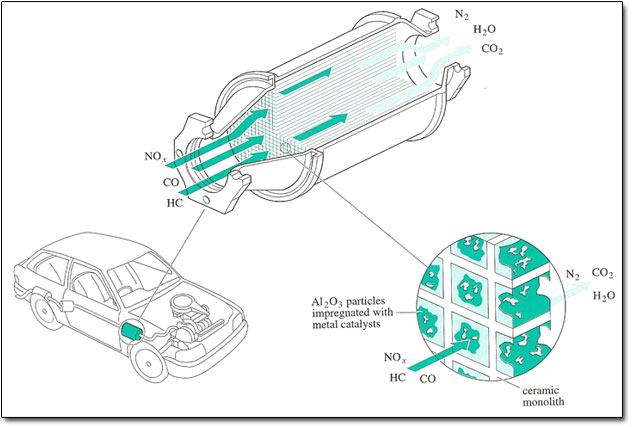 Lean Burn Through the provision of higher compression ratios, both gasoline and diesel lean-burn engines generally enjoy higher fuel economy, improved performance and cleaner exhaust emissions than that of conventionally tuned engines. By nature they use less fuel and emit fewer unburned hydrocarbons and greenhouse gases while producing the equivalent power of similar sized combustion engines. Advantages • Significant improvement regarding fuel efficiency • Reduction of emissions without the addition of a catalyst • Due to excess oxygen being available, this makes the combustion process more efficient therefore more power is produced. • Due to the engine running in a lean burn mode rather than rich, this makes for cooler running of the engine, which in turn aids in extending the life and reducing the amount of required maintenance. Disadvantages • Increased exhaust NOx emissions • Narrower RPM power band • Often the engines require more complex catalytic converters • limited to use within light passenger vehicles In the early 90s GDI (gasoline direct injection engines) were used through manufactures such as Mitsubishi, Toyota and Nissan. It was throughout the 2000s that manufacturers such as Ford, Volkswagen and BMW started using direct injection engines due to its leaner fuel mixtures, higher power outputs and general design advantages. 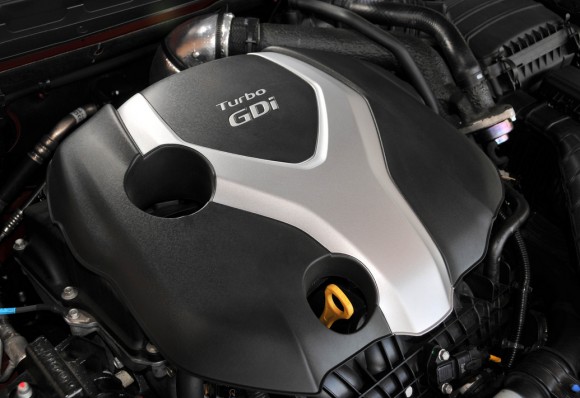 “They achieve lean-burn status by employing higher combustion chamber compression ratios (higher cylinder pressure), significant air intake swirl and precise lean-metered direct fuel injection.” Fuel Injection The air/fuel mixture can be prepared by either a carburettor or a fuel injection system. In both cases fuel will be present in the inlet manifold as vapour, liquid droplets and a liquid film. Benefits compared to carburettors: • More accurate in terms of controlling the fuel/air mixture • Higher peak power achievable due to no restriction by the carb venture • Better emissions due to better fuel/air mixture • Improved reliability • Smoother and more dependable performance • Precise fuel distribution results in better fuel economy • Adapts better to an increased variation in environment temperature • “The original purpose of fuel injection was to obtain the maximum power output from an engine. The pressure drop in a carburettor impairs the volumetric efficiency and reduces its power output.” 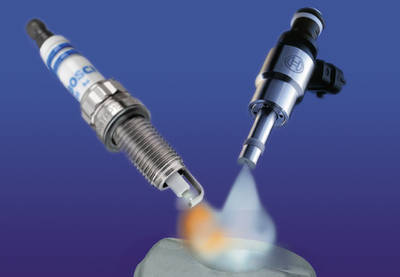 Drawbacks compared to carburettors: • Requires more effort physically to swap from one engine to another • Slower throttle response; this is due to having to wait for the sensors to feed the information to a computer. • Harder to adjust, troubleshoot, configure or rebuild • Carburettor engines will be cheaper to purchase and install • Fuel injection requires a much higher fuel pressure; this means that routing and integrity become extremely important. • Due to the small size of the injectors, this means that there is always a possibility of clogging. FSI (Fuel Stratified Injection) “With FSI technology, fuel is injected directly into the combustion chamber. The injector, located on the admission side in the cylinder head, is served by a high-pressure pump driven by the camshaft and a pressure reservoir shared by all cylinders – the common rail system.” This, coupled with the advantages of petrol direct injection, plays a crucial role in boosting thermodynamic efficiency compared with both manifold injection engines and turbo engines.  If we were to compare the new FSI engine technology against a conventional engine with fuel injection, the main areas in which FSI technology would reign supreme would include the general dynamics of the new system, an increased power and torque output and a decrease of fuel consumption of up to 15%. | “The main factor contributing to these improvements is the stratified charge principle at part load. In this operating mode, the engine only needs a fuel-air mixture capable of immediate ignition in the area around the spark plug. The remainder of the combustion chamber is filled with a leaner mixture, that is to say one with a considerable degree of excess air.” It is such developments which make this new technology not only extremely attractive to today’s automobile consumers, but also benefits manufacturers within the VW groups, in terms of being seen as a company which is keeping up with the times in trying to aid in a greener lifestyle, whilst ensuring the driving enthusiast is still kept pleased. HCCI This system combines the best properties of diesel and gasoline engines by mixing the fuel homogenously with the air in the combustion chamber. This is something which is very much similar to that of a spark ignition engine, but with a high proportion of air to fuel (lean mixture). When the piston reached top dead centre on the compression stroke the gaseous mixture ignites automatically from the compression heat rather than from a spark plugs assistance. This makes for low fuel usage and reduced emissions. Advantages • More efficient burning of fuel and at reduced temperatures • Compatible with both gasoline and E85 fuel • Elimination of frictional pumping losses due to throttle-less induction system • Reduction of harmful emissions compared to conventional spark ignition engines • “Lean combustion returns 15 percent increase in fuel efficiency over a conventional spark ignition engine.” Disadvantages • Power range limited when compared to a conventional spark ignition engine • Dependance on strengthened engine construction, due to higher cylinder pressures • More expensive to produce • Increased difficulty with regards to increase in phases of combustion characteristics “Technical breakthroughs are needed. Despite the company's financial crisis, GM prioritized the HCCI technology and is speedily moving towards production. It can be anticipated that gasoline HCCI is not likely to be ready for the market by 2012, and maybe even 2015. However, diesel-fuel HCCI or HCCI-like diesel engines (with no SI assist) will possibly be introduced by 2012.” Multi Air Technology On March 8 2009, Fiat used the Geneva Auto Show to launch a new engine technology which would aid in reducing harmful emissions whilst increasing outright engine performance. Dubbed the MultiAir it offers an increase in control with regards to the flow of air taken in during the combustion cycle. Other benefits include reduced fuel consumption and an increase in effectiveness when used with either a supercharger or diesel engine. 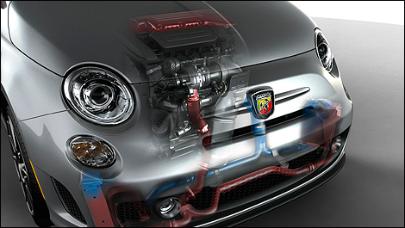 “Fiat claims Multiair is a fundamental breakthrough in petrol engine design that will dramatically cut fuel consumption, as well as significantly boosting power and torque, cutting carbon dioxide emissions by between 10 and 25 per cent, and up to a 60 per cent reduction in other engine pollutants.” By achieving an overall higher performance output from the system, Fiat will be able to replace their current engines with smaller more efficient ones. It is important to note that Fiat has not relinquished ownership of the new system, therefore allowing licensing of the system to other vehicle manufacturers such as Alfa Romeo. Benefits Listed include; • Maximum power increase of up to 10% • Improvement of lower torque range • 10% reduction in fuel consumption and C02 emissions • Potential for use in diesel engines • Emission reductions ranging from 40% for (HC/CO), and up to 60% cut in oxides of nitrogen. • Applicable to all internal combustion engines, regardless of fuel used. Such benefits allow Fiat to maintain its current lead in low emissions and low fuel consumption technology. The rotary engine and its issues “Wankel’s rotary engine is an internal combustion engine which uses the same principle of converting pressure into rotating motion, but without the vibrations and mechanical stress at high rotational speeds of the piston engine.”  Although the rotary engine could be deemed a success in many areas including size, weight and performance figures, if we are to look further into emission standards and fuel consumption we would be likely to find issues such as those listed below: • Imperfect sealing against the chamber ends, or leakage between the adjacent chambers, resulting in an unburned fuel mixture. • A 50% longer stroke duration compared to a piston engine. • Overall the engines operation makes for more carbon monoxide and unburned hydrocarbons being present within the exhaust fumes. • High fuel consumption is its main disadvantage • Comparison tests have shown how a Mazda rx8’s rotary engine managed to use, more fuel than a v8 engine with over four times the displacement and comparable performance figures. • Increased running costs due to the constant requirement for oil refills. (Rotary engines may be adjusted/tuned in order to run on bio-ethanol, or otherwise known as E85) Evidence of the engines high fuel consumption and C02 emissions, can be seen in the link provided below. http://www.parkers.co.uk/cars/reviews/facts-and-figures/mazda/rx-8/coupe-2003/running-costs/ |
