1. Kinetic Energy Recovery Systems KERS or otherwise known as a kinetic energy recovery system, first used in the 2009 F1 season, was introduced as a technology which could promote the development of environmentally friendly and future road car technologies within Formula One racing. The main purpose of the technology is to recover kinetic energy that could potentially be lost from the waste heat generated in the vehicles braking process. Once this energy has been collected, it is stored and can be converted into power when required by the driver. This is done through a button on the vehicle steering wheel. Such an increase in power assists in the process of both overtaking and defending a driver’s position when out on circuit. 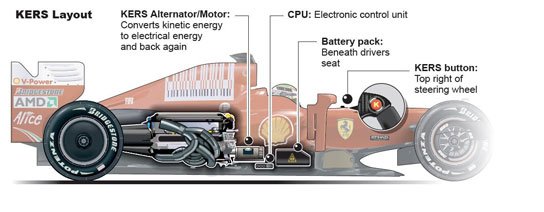 Regulations currently allow KERS systems a maximum of approximately 80bhp, this extra power is available for up to 6.67 seconds per lap. The amount used per lap is entirely up to the driver in question, though the lap time achieved can benefit by approximately 0.1 to 0.4 seconds. “There are principally two types of system - battery (electrical) and flywheel (mechanical). Electrical systems use a motor-generator incorporated in the car’s transmission which converts mechanical energy into electrical energy and vice versa. Once the energy has been harnessed, it is stored in a battery and released when required. Mechanical systems capture braking energy and use it to turn a small flywheel which can spin at up to 80,000 rpm. When extra power is required, the flywheel is connected to the car’s rear wheels.” 1. Flybrid Kinetic Energy Recovery System Designed to meet the FIA regulations for the 2009 Formula One season the flybrid kinetic energy recovery systems key features included; - Weighing in at 25kg it was made of steel and carbon fibre that rotates at over 60,000 RPM within an evacuated chamber - To avoid the escape of any debris in the case of flywheel failure, the flywheel casing featured containment - Flywheel connected to the transmission of the vehicle on the output side of the gearbox via several fixed ratios, a clutch and the CVT - In either storage or recovery the transmission contained 60kW power - Designed to fit within the tight packaging constraints of an F1 car 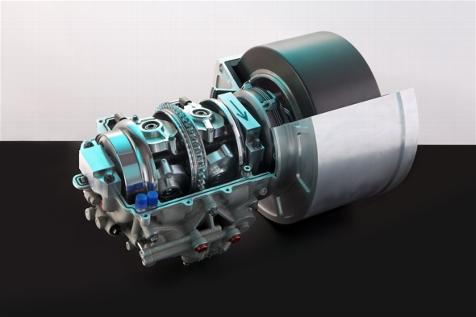 |
3. Bosch Developed Modular (KERS) “Hybrid systems by Bosch Motorsport always comprise a battery, the electric motor, and the KERS controller. This contains the power electronic, the battery management, and the management system for hybrid and engine functions. A lithium-ion battery with scalable capacity or a flywheel energy storage device is used for storing energy. The latter stores up to 750 kilojoules of energy. The electric motors weigh between four and eight kilograms with a maximum power level of 60 kilowatts.” 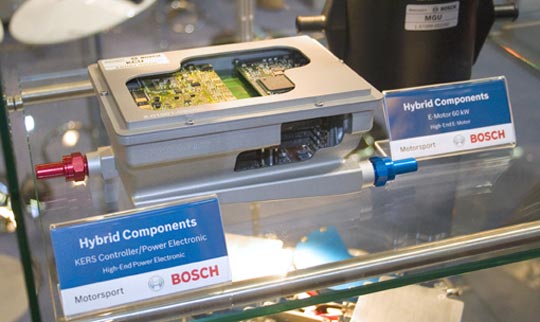 4. Efficiency Comparison of Mechanical system to Electric/Chemical systems - Mechanical energy does not change state - Lithium ion batteries within electronic KERS get hot and require additional ducting - Chemical batteries heat up increasing the possibility of explosion - Lithium ion batteries take 1-2 hours to charge completely due to lower specific power, hence such a large amount of batteries are required - The requirement for mass production batteries that meet the demands of F1 - Flywheels are easy to recycle in comparison to the rare earth materials used to make the batteries are more expensive to recycle - Specific power is lower due to the energies multitude of tasks which must be carried out Overall it is assumed from facts such as the ones listed above, that mechanical systems are more efficient than electrical or chemical based systems. 5. F1 KERS Incidents - In 2007 Christian Klein was testing at Jerez in BMW F1’s car which had been modified to use KERS, when returning back to the pits a mechanic was violently thrown to the ground after touching the vehicle. (why?) The link provided below shows a KERS incident in which a mechanic receives a violent electrical shock; - In 2007 Red Bull Racing were forced to evacuate the factory when a fire alarm was triggered due to a KERS battery experiment going wrong - In 2012 after Williams had claimed victory at the Spanish Grand Prix, a fire believed to be sparked by a KERS unit, injured up to 31 people who had been within the team's garage. |
