The Greenpower Education Trust A registered charity, the Greenpower Education Trust, aims to change the public’s current views on engineering through the use of education. By linking education, industry and community through its variation of projects, it can aid in solving the problems faced by society, such as sustainability. Being a registered charity Greenpower is reliant on donations in order to be able to continue inspiring and enthusing today’s young generation. Thanks to one-off donations, regular donations and some of their corporate partners, such as Siemens, The Liverpool Motor Club and Unipro this has allowed them to meet their vital mission objectives. IET Formula Goblin • Aiming to inspire people, between 9 -11years of age, into the field of engineering in a fun, innovative and practical way. • Not only does it encourage schools to include the project within their curriculum but also encourages parental participation at clubs and events. • Comes as a flat pack kit, in which a team of individuals can use a step by step manual to construct their very own Formula Goblin whilst building on their early mechanical skills. • The end product is a fully functional car and may be taken to a variety of events across the United Kingdom. • Possibility of gaining support from external businesses which allows for bonding between organisations. • Demonstrates integration of areas such as maths, design technology, electricity and materials. 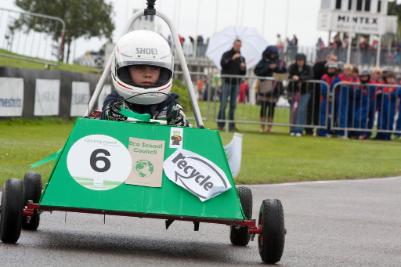 IET Formula 24 • Aimed at ages 11 – 16, Formula 24 is aimed at secondary schools, youth groups and private individuals. • Each team is provided with the same electric motors and six 12 volt batteries which are required to be used in pairs. • All designs must meet provided regulations, though the design is still something that can come from the designer’s imagination. • Teams must compete in one regional heat, that being a four hour endurance race. The top three of these heats qualify for a national final which is held at the Goodwood motor circuit. 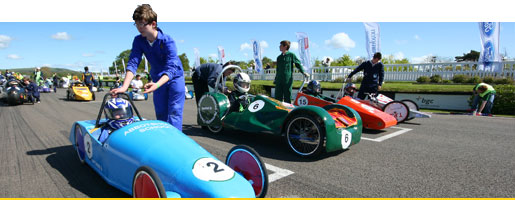 IET Formula 24+ • Aimed at ages 16-25, Formula 24+ is aimed at sixth forms, youth groups, apprentices and universities. • Design and build an electric car with a standard electric motor and sets of batteries. It is essential that all regulations are met. • Powered by a 24 volt, 240 watt, DC Fracmo electric motor and two 12 volt MRT35T batteries both items of which are supplied by Greenpower. • Eight rounds, each ninety minutes in duration. • Teams must enter at least three events including the final round at Goodwood Circuit. • The championship table is determined by the team’s top three results 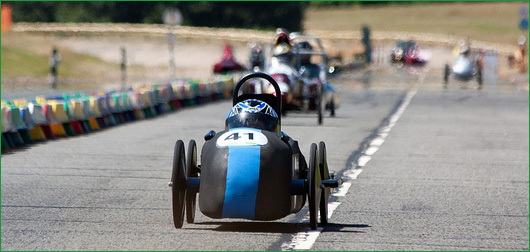 Corporate Challenge • Aimed at businesses it allows today's engineers to pit their expertise against the Formula 24’s top teams. • The technical regulations are the same of that of the Formula 24, each team having six 12 volt batteries which must be used in pairs. • Such a team exercise can result in a great opportunity for team building and problem solving to take place in a completely different environment to the working norm. • Minimum of three drivers per team • Maximum of six team members acting as mechanics and pit crew • Drivers must be aged 16 or over, or have competed in a minimum of one National Final or Corporate Challenge. 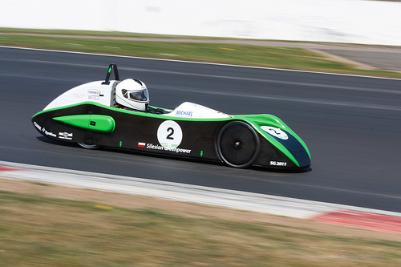 Tesla Roadster First introduced as a prototype in 2006, the Tesla Roadster was first announced in 2008 as officially being produced. With a top speed of 125mph, 0-60 mph in 3.9 seconds, 302 horsepower (up from 52 at its launch) and a claimed range of 245 miles when fully charged, the Tesla Roadsters facts are enough to impress and attract the regular petrol head, whilst putting itself in competition with the likes of Lotus. It is powered by 6,831individual lithium-ion cells which take 3.5 hours to charge from empty and a 375 volt AC induction air-cooled electric motor with variable frequency drive. The expected battery life for the system is seven years or up to 100,000 miles. By replacing a standard gasoline motor with such a system and the replacement of a gearbox with a single speed fixed gear, that makes the Tesla Roadster so light, agile and sporty. Tesla will sell the Roadster until early 2012; this is due to its contract with Lotus Cars for 2,500 gliders which expired at the end of 2011. | 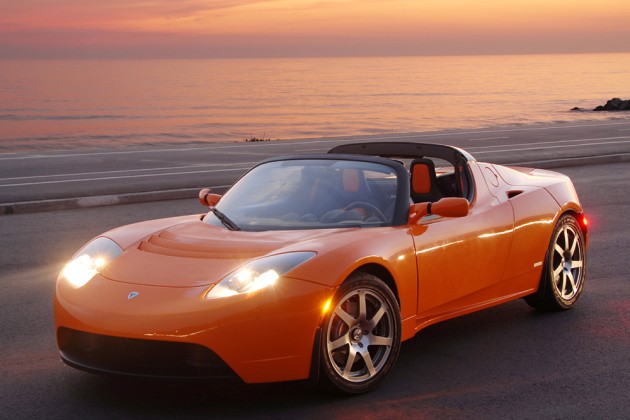 In terms of feedback of miles gained from the vehicles claimed 245 miles since its release, these have been of a positive response with the majority of tesla’s customers achieving over 200 miles per charge on average. Back in 2009 the Tesla Roadster managed to achieve 313 miles when travelling through the Australian outback in the Global Green Challenge. In the case of claims being made that the vehicle was under achieving with regards to mileage gained from one full charge, when the vehicles were tested they were found to be driven in an uneconomical manner, and not to that of the recommended guidelines. Tesla Model S With deliveries of the Tesla Model S having begun in the US in June, the new vehicle aims to be an alternative to such cars as the Mercedes E-class, the Audi A6 and the 5 series BMW. Listed below are some facts and figures on Tesla’s latest invention: 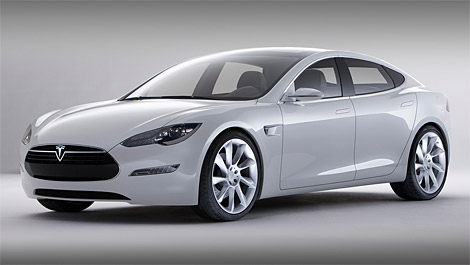 - Choice of a 40 kWh (160 mile range), 60 kWh (230 mile range) and a 85 kWh (300 mile range) battery, depending on owner preference. - Advanced electric powertrain with only one moving piece: the rotor - Automotive-grade, lithium-ion battery technology - Liquid cooled, the battery maintains consistent temperatures to prevent overheating of cells. - Able to be plugged into 240 volt, 120 volt outlets and public stations - Active air suspension provides improved ride and handling, the system can lower the vehicle for optimized aerodynamics - 20,000 to be produced each year - Rear wheel drive, 0-60 in 4.4 seconds and a top speed of 130 mph How can fuel cells produce electricity? “In a fuel cell the fuel does not react directly with the oxidant, but instead delivers its electrons to the anode. The electrons then flow to the cathode where they are taken up by the other reaction partner, typically atmospheric oxygen. By this, the reaction can be controlled and carried out with high current efficiency.” Alkali fuel cells – Operate on compressed hydrogen and oxygen, previously used in Apollo spacecraft to provide electricity and drinking water. Proton Exchange Membrane fuel cells – work with a polymer electrolyte in the form of a thin permeable sheet. Solid Oxide fuel cells – Use a ceramic compound of metal oxides as electrolyte, high temperatures limit the application of the unit. Phosphoric Acid fuel cells – Phosphoric acid used as the electrolyte, internal components must be able to withstand corrosive acid. Molten Carbonate fuel cells – High temperature compunds of salt carbonates as the electrolyte, carbon dioxide must be injected so to compensate for the carbonate ions used in the reactions. “In 1839, the first fuel cell was conceived by Sir William Robert Grove, a Welsh judge, inventor and physicist. He mixed hydrogen and oxygen in the presence of an electrolyte, and produced electricity and water. The invention, which later became known as a fuel cell, didn't produce enough electricity to be useful.” 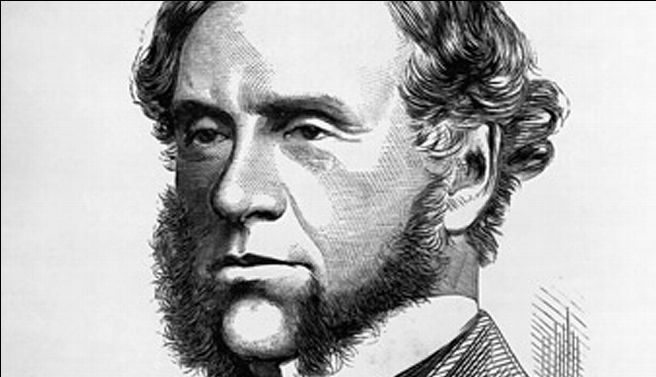 Issues with fuel cell powered vehicles - Requirement for a source of hydrogen in order for the fuel cell to operate - Hydrogen is still closely linked to the use of fossil fuels - Complication being able to build efficient and reliable fuel cells makes them expensive - Lack of places in which fuel cells can be refuelled - Possible requirement for a reformer to turn hydrocarbon or alcohol fuels into hydrogen Electric Karts With technology constantly advancing and the environment becoming an even greater concern, electric go-karts are becoming ever more popular. Not only are they beneficial due to their ability to eliminate the production of toxic fumes and pollutants, but they also reduce noise pollution that would usually be generated, allowing for such karts to be used in more residential areas and not limiting their areas of usage. With comparisons made on fuel prices, noise pollution, labour and maintenance costs and outright performance, electric is becoming the go to option. Design considerations: • Electric kart batteries will have to be checked weekly so to ensure batteries maintain the best possible lifespan. • All maintenance carried out must be done by a trained electrician so to ensure no injury or harm as a result of a lack of knowledge when working with high voltages. • Designing karts so that batteries can easily be removed and inserted when required to recharge • The karts will need to be charged in order to run, this will require for some kind of charging socket or device. • Electric karts usually weigh considerably more than petrol driven karts, for this reason safety is even more vital as crashes will result in larger impacts. • Any potentially dangerous parts that could cause electrocution should be well covered and protected from contact with bare skin. • The electric motors must have sufficient ventilation to ensure they do not overheat |
